Showing posts with label unemployment. Show all posts

Tuesday, September 13, 2011

Sobering Statistics

14 million able bodied Americans are out of work. That's a robust 9.1%. It's worst in Nevada (12.9%) and California (12.0%). It's 10% or above in 8 other states plus the District of Columbia. 

As if that news weren't sobering enough, the U.S. Census Bureau released their annual report Income, Poverty and Health Insurance Coverage in the United States (2010).  

46 million Americans now live in poverty, an addition of 2.6 million impoverished since last year's count. That's 15.1% of all Americans live in poverty. 15.1%. That's more than 1 in 7 Americans. 

50 million Americans are without health care coverage. That's 16.3%, or nearly 1 in 6 Americans. 

Nationally, median household incomes have declined -2.3% since last year, or $1,154 per family. 

The Congressional response to these trends in employment, income, poverty, and lack of healthcare coverage is startling. Slash federal spending, push to reduce benefits from entitlement programs, challenge legality of the health care reform law, all while steadfastly refusing to raise taxes on wealthy individuals and corporations in order to cover the revenue gap. 

Our country is hurting ... badly. And Congress is more interested in protecting special interests than in helping our citizens weather this storm. Shame on them. And shame on us for electing them. 

Voters get what they deserve. 


Friday, September 9, 2011

President Obama Steps Up

Whether you think President Obama has been a disappointment (liberals) or is out to destroy America (conservatives), he stepped up last night with his jobs speech

He proposed a plan in which he'd:

1. Put construction workers back to work with direct investment in infrastructure, particularly roads, bridges, airports, railways, and schools. Huge and much needed investment that would greatly help one of the hardest hit job sectors. 

2. Put teachers back to work in the classroom so our kids can get an adequate education. Given the systematic GOP effort to destroy teacher's unions, I don't think this will be popular. 

3. Create tax incentives for businesses to hire the long-term unemployed. Not sure if the incentive ($4,000 per new employee) is strong enough, but it can't hurt, but it's a tax break so the GOP will love it. 

4. Develop a jobs program for veterans. After they've risked their lives for our country, they shoudln't have to fight for a job when they get back. 

5. Create incentives for companies to innovate here and keep jobs here. 

6. Extend unemployment benefits again. Probably the least popular idea of the night for the Republicans in the room, except for .... 

7. Pay for this by eliminating tax loopholes and having the rich pay their fair share. 


Predictably, Rand Paul's response was hyper-critical of the president and devoid of any ideas. After briefly blaming the president for the current economy, he gets on his deficit reduction horse, which is completely comical. He then lays out 5 ideas:

1. Balanced Budget Amendment to the U.S. Constitution. How this creates jobs is anyone's guess outside of teaville. It's also an absolutely moronic idea since deficit spending actually increases growth when our interest rate on our debt is so absurdly low.

2. "The Penny" Plan. Cut federal spending by 1% per year for 6 years and then freeze spending for 2 years. At this point, according to his math, the deficit will be eliminated. But about 30% of the GDP is government spending, so a 1% reduction would put a 0.3% drag on GDP. At 6 years that would be a full 2% drag on GDP. Great idea, huh?

3. Half the Corporate Income Tax & Eliminating Capital Gains Taxes (So Warren Buffett would pay ZERO taxes). As I've previously explained, corporate income taxes do not affect jobs. A lower corporate income tax actually incentivizes thrift by corporations. 

4. Regulatory Moratorium. No new regulations (apparently ever). And repeal one regulation every week until the economy starts recovering. Yes it might help, because we could start raping the environment at wll, which would certainly create jobs. So in other words, get ready for an unsafe environment, unsafe roads, unsafe food, unsafe drugs. What an insipid "idea". Fortunately, most Americans and most of Congress aren't as stupid. 

 5. Entitlement Reform. So I guess this spells out how he's planning on achieving a "Penny" Plan. On the backs of retirees, the unemployed, and the ill.

Nice work, Senator. Give huge tax breaks to the wealthy and screw the rest of us. 

Tuesday, August 23, 2011

Stimulus didn't work?

The American Recovery and Reinvestment Act (ARRA), better known as the "stimulus package", was signed into law in February 2009. In the wake of this large (and it was large, though not massive) spending package, a wide variety of people came out to say "it didn't work" ...

These ranged from free market Milton Friedman swooning economists who cringed at the idea of Keynesian economic theory being implemented after their own policies failed the country abysmally to CEOs of large companies that gained financially through the stimulus, to state governors who claimed it was wasteful while accepting $28.5B in money for their own states (I'm looking at you Rick "The Idiot" Perry).

Now Perry I can understand. He's running for president against President Obama so facts don't matter to him. I mean, he closed 97% of his state government's budget deficit using stimulus money and he took a great deal of credit for jobs created while he was spending that $28.5B in stimulus funding in his state.

The CEO at least waited a year before making his pronouncement. Of course, he did what a CEO was supposed to do - review the effects of the stimulus on his own bottom line. Interesting that within weeks of this pronouncement, Intel was given a tax exempt bond issuance to build a new semi-conductor factory and upgrade adjacent facilities in Oregon. That ol' CEO has been silent since then on the success of the stimulus. Convenient for him and his shareholders.

But the economists? Well, the economists are slaves to their ideology - claiming the stimulus didn't work just a few months after it was enacted. But they're careful. These sneaky economists were very, very careful ... they pointed to the lack of increase in personal consumer spending as a sign the stimulus didn't work ... and this from data dating only through June 2009. This is convenient for them, because stimulus funding didn't begin allocation until the 3rd fiscal quarter in 2009 (April 1-June 30) so they were looking at the effect of $36B in stimulus on a single indicator to demonstrate for their fellow free market rag, The Wall Street Journal, that Keynesian economic theory is a failure. What a load of bullshit.

But more economists spoke out, right? That's right, in a survey of 68 private sector economists,  50 (73%) said the stimulus didn't increase hiring for their companies, but 39 (57%) said that demand for their services was rising - they just apparently didn't think the stimulus was causing that demand.  This was 68 economists employed by businesses. How many economists are employed by businesses? Where did they work? What was their motivation? As someone who does survey research as part of my job, 68 is a very low sample size to draw such an enormous conclusion. Of course, if I could get that much press by surveying 68 conflicted individuals, I'd be a fool not to. I'm sure the National Association of Business Economists was well compensated for their findings.

But getting away from the claims of ideological zealots, politicians, and CEOs looking for a handout, what do the data actually tell us? The stimulus package has largely run out of money. Approximately $670B of an expected $787B has been paid out. So 85% of the money has been spent. A fair amount of the remaineder may end up being unallocated, so we've basically seen the bulk of the money having been spent over the past 2 years. What did it get us?

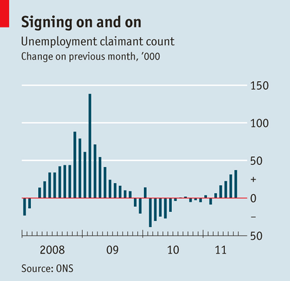
Well, one indicator is the job growth rate, since a big part of the stimulus was to get the labor market moving again. Take a look at the chart below from The Economist:


See that big spike? That's February 2009 - the month the stimulus was signed into law. We see an immediate and steep decline in jobless claims, which once the money started being received around April 2009, declined steadily until joblessness plateaued around the middle of 2010, presumably after many of the jobs created by the stimulus had been filled. But stimulus money began to run out for many of the projects over the past few months and look at that ... jobless claims are climbing again in mid-2011. But remember, the stimulus didn't work.

Now lets look at the effect on GDP.


So by the 2nd quarter 2009 (this isn't fiscal quarters) we see a big bump, coinciding again, with the stimulus package. Yes, GDP is a very gross measure, but there wasn't a whole lot going in with the economy at this point so how else do we explain this rapid movement from -4% retraction to +4% growth in just 2 quarters? It's tough to explain otherwise. Sure, the Fed was doing its own tweaking of the economy, but it would be tough to imagine that infusing the economy with an additional ~$150B in spending each quarter wasn't helping anything. To claim that the stimulus didn't work.

So what's been happening as the stimulus has wound down? No big surprise. Growth is anemic. The original 1.9% 1st quarter GDP in 2011 (seen in the 2nd figure above) was revised down to just 0.4% "growth" ... and the 2nd quarter wasn't much better at 1.3%. The slowest growth since the stimulus package was enacted 2 years ago. Some economists (those with a mind of their own?) now think we're headed to a double dip recession as the stimulus funding runs out and austerity cuts are enacted at the wrong time.

Notice nobody's come back out and admitted they were wrong? Not a big surprise, really. Ideologues, politicians, and capitalists can't (or won't) change their spots.

Sunday, August 7, 2011

Debt Deal Fallout

Let's see. In the few days since the debt deal was announced:

The New York Stock Exchange took the 9th worst single day plunge in its history.

S&P downgraded US treasury bonds for the first time since US treasury bonds began being rated.

The U.S. Postal Service announced plans to shut 2,500 post offices around the country (16% of all post offices) and cut tens of thousands of jobs.

HSBC announced plans to cut 30,000 jobs from their workforce by 2013.

This is only the beginning of the double dip, folks. We're headed for more pain, weak if any growth, a more sustained jobless period, and a continued widening inequality between the wealthy and the rest of us. Federal programs aiding the poor are being cut while no taxes will be raised on the wealthy, so the incomes of the poor will decline while the rich continue on unabated.

This is unsustainable. If the middle class, which has already been decimated by the financial crisis, doesn't have disposable income to spend, there won't be any growth. The lower 90% of the country is responsible for 70% of consumer spending. If they don't have anything to spend, the economy can't grow. At least not robustly enough for the private sector to pull our economy out of the high unemployment rut we're stuck in.

The solutions for all of this are simple, and unfortunately, toxic to many of our elected officials and the rabid tea partiers who are now given outsized power in our representative government. We need to throw the bums out in 2012. Unfortunately, as usual, the wrong bums will probably get thrown out. Those willing to govern rather than pander to special interests and compromise rather than stand as rigid ideologues.

As usual, voters get what they deserve.

We can do better.

Sunday, February 20, 2011

Proud to be an American?

I liken the U.S. to Sir Winston Churchill's quote ... "Democracy is the worst form of government, except for all those other forms that have been tried." I'd say America is the worst country to live in, except for all the others. 


That's not exactly true, of course. There are a number of lovely countries with idyllic landscapes, great weather, robust economies, and representative (free) governments. But the U.S. with its unparalleled freedoms, cultural diversity, widely varying topography, ample arable land, etc. is a pretty unique place in the world. 


But our American exceptionalism has disappeared. Evaporated. 


Take a look at this graphic from the New York Times. And then let's break it down column by column.  


1. We now have higher income inequality than all but Hong Kong and Singapore among "Advanced Economies". Analogous to this, though not shown in the figure, is that wages as a percentage of U.S. GDP have reached an all-time low. Let me repeat that. Wages - our paychecks - have reached an all-time low as a percentage of our economy. Since the government began keeping statistics on this issue, at no point have American workers taken home a smaller piece of the economic pie.  


2. The second column reflects the current unemployment rate for each advanced economy. As you can see we're not the worst at 9%, but we're at more than double a number of "social democracies", which are supposedly bad for business. Well, we're at a point where "bad for business" means "good for workers" so we're at a stalemate I guess. 


3. "level of democracy" ... should be our bread and butter, right? Nope. We're in the middle of the pack. I haven't researched how this metric is calculated, but if we take it on face value we're pretty much "average" when it comes to our democracy, at least among advanced economies.


4. "wellbeing index" ... that's the percentage of our citizens who are "thriving" ... we're at 57% ... or middle of the pack again. 


5. "food security" based on a question about whether in the past 12 months people have lacked having enough money to put food on their table. This is expressed as a percentage of the country. A full 16% of Americans answered yes to this question. 16% of us have not had enough money to adequately feed our families or ourselves in the past 12 months. Compare that to 3% in Denmark. Or 6% in Germany. 


6. Life expectancy at birth. Here we're in the "red zone" ... We rank ahead of just 5 of the 32 other advanced economies. We're fat. We're unhealthy. We're eating copious amounts of processed foods high in salt and preservatives. We have limited access to quality health care thanks to our predominantly employer-based private health insurance system. It's now being estimated that our children will have shorter life expectancy than we do.


7. We have more than twice the prison population (as a percentage of our citizens incarcerated) of any other advanced economy. 


8. We now rank equivalent to the Czech Republic in math and science scores based on international standardized tests. The Czech Republic. 


We can do better, people. But it requires cooperation, hard work, and sacrifice. All things that seem to be rapidly becoming exceptional behaviors in our republic.