The American Recovery and Reinvestment Act (ARRA), better known as the "stimulus package", was signed into law in February 2009. In the wake of this large (and it was large, though not massive) spending package, a wide variety of people came out to say "it didn't work" ...
These ranged from free market Milton Friedman swooning economists who cringed at the idea of Keynesian economic theory being implemented after their own policies failed the country abysmally to CEOs of large companies that gained financially through the stimulus, to state governors who claimed it was wasteful while accepting $28.5B in money for their own states (I'm looking at you Rick "The Idiot" Perry).
Now Perry I can understand. He's running for president against President Obama so facts don't matter to him. I mean, he closed 97% of his state government's budget deficit using stimulus money and he took a great deal of credit for jobs created while he was spending that $28.5B in stimulus funding in his state.
The CEO at least waited a year before making his pronouncement. Of course, he did what a CEO was supposed to do - review the effects of the stimulus on his own bottom line. Interesting that within weeks of this pronouncement, Intel was given a tax exempt bond issuance to build a new semi-conductor factory and upgrade adjacent facilities in Oregon. That ol' CEO has been silent since then on the success of the stimulus. Convenient for him and his shareholders.
But the economists? Well, the economists are slaves to their ideology - claiming the stimulus didn't work just a few months after it was enacted. But they're careful. These sneaky economists were very, very careful ... they pointed to the lack of increase in personal consumer spending as a sign the stimulus didn't work ... and this from data dating only through June 2009. This is convenient for them, because stimulus funding didn't begin allocation until the 3rd fiscal quarter in 2009 (April 1-June 30) so they were looking at the effect of $36B in stimulus on a single indicator to demonstrate for their fellow free market rag, The Wall Street Journal, that Keynesian economic theory is a failure. What a load of bullshit.
But more economists spoke out, right? That's right, in a survey of 68 private sector economists, 50 (73%) said the stimulus didn't increase hiring for their companies, but 39 (57%) said that demand for their services was rising - they just apparently didn't think the stimulus was causing that demand. This was 68 economists employed by businesses. How many economists are employed by businesses? Where did they work? What was their motivation? As someone who does survey research as part of my job, 68 is a very low sample size to draw such an enormous conclusion. Of course, if I could get that much press by surveying 68 conflicted individuals, I'd be a fool not to. I'm sure the National Association of Business Economists was well compensated for their findings.
But getting away from the claims of ideological zealots, politicians, and CEOs looking for a handout, what do the data actually tell us? The stimulus package has largely run out of money. Approximately $670B of an expected $787B has been paid out. So 85% of the money has been spent. A fair amount of the remaineder may end up being unallocated, so we've basically seen the bulk of the money having been spent over the past 2 years. What did it get us?
Well, one indicator is the job growth rate, since a big part of the stimulus was to get the labor market moving again. Take a look at the chart below from The Economist:
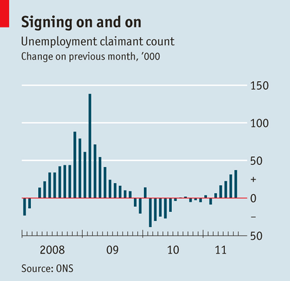
See that big spike? That's February 2009 - the month the stimulus was signed into law. We see an immediate and steep decline in jobless claims, which once the money started being received around April 2009, declined steadily until joblessness plateaued around the middle of 2010, presumably after many of the jobs created by the stimulus had been filled. But stimulus money began to run out for many of the projects over the past few months and look at that ... jobless claims are climbing again in mid-2011. But remember, the stimulus didn't work.
Now lets look at the effect on GDP.
So by the 2nd quarter 2009 (this isn't fiscal quarters) we see a big bump, coinciding again, with the stimulus package. Yes, GDP is a very gross measure, but there wasn't a whole lot going in with the economy at this point so how else do we explain this rapid movement from -4% retraction to +4% growth in just 2 quarters? It's tough to explain otherwise. Sure, the Fed was doing its own tweaking of the economy, but it would be tough to imagine that infusing the economy with an additional ~$150B in spending each quarter wasn't helping anything. To claim that the stimulus didn't work.
So what's been happening as the stimulus has wound down? No big surprise. Growth is anemic. The original 1.9% 1st quarter GDP in 2011 (seen in the 2nd figure above) was revised down to just 0.4% "growth" ... and the 2nd quarter wasn't much better at 1.3%. The slowest growth since the stimulus package was enacted 2 years ago. Some economists (those with a mind of their own?) now think we're headed to a double dip recession as the stimulus funding runs out and austerity cuts are enacted at the wrong time.
Notice nobody's come back out and admitted they were wrong? Not a big surprise, really. Ideologues, politicians, and capitalists can't (or won't) change their spots.
Policy, Economics, and Politics of the people, by the people, and for the people. Opposed to kakistocracy (rule by the worst) and kleptocracy (rule by thieves) in all forms. Leadership without compassion is brutality. Capitalism without morality is piracy. Success without integrity is failure. Good governance advocate.
Showing posts with label stimulus. Show all posts
Tuesday, August 23, 2011
Wednesday, April 13, 2011
The Debt is Coming, The Debt is Coming!
Okay, I'll play.
We've known for ages that the National Debt was an albatross around the necks of our future solvency. And as should be expected in our attention deficit afflicted political system, the unpopular choices have been kicked down the road time and again.
Let's start our story in 1993 when President Bill Clinton and Congress passed the Omnibus Budget Reconciliation Act of 1993. Built into the act was a mandate to balance the federal budget over a number of years.This passed without a single Republican vote. Let me repeat that. Without a single Republican vote.
By the year 1998 this had been achieved. We had a budget surplus for the first time in 30 years. The economy was humming and our house was in order.
By 2004 we were running record deficits. In the middle of a boom period. Record deficits.
What the hell happened?
9/11 happened and then we went to war. Military spending skyrocketed. Then the Bush tax cuts happened and tax revenue plummeted. Between the increased costs of the wars and the decreased revenue, we ended up in pretty deep deficits.
The typical rule of thumb has been "surpluses in good times, deficits in bad times" ... this, of course, makes perfect sense. When the economy is going well there's less demand for support services and the tax revenue received can be saved for a rainy day. During bad times that surplus can be tapped into to make up for lost tax revenue through the economic decline. It's a perfectly reasonable and sustainable approach to government spending.
And that's largely what we did as a nation until relatively recently. There was no reason - zero - for not running a continued surplus or at least only a minor deficit from 2002-2007. Usually, when our country has gone to war, taxes have been raised to pay for the fight. An unpopular war is one that voters rise up against, because their tax dollars are not being put to good use. We didn't have that reaction to Afghanistan and then Iraq, because it didn't feel like we were paying for it ... but we were ... and our children will since it was all added to the National Debt.
Then things went in the shitter. In 2007 the bottom fell out of the housing boom. In retrospect it looks almost inevitable, but at the time a lot of supposedly smart people got caught with their pants down.
Our record deficits we were running during the boom from 2004-2007 became astronomical in the "Great Recession" of 2008-2010. Why? Well, again, it's pretty simple.
1. More people need support services during bad times.
2. Tax revenues declined as they always do during a recession.
3. We're still at war.
Now we have an astronomical deficit and a rapidly increasing National Debt, which will quickly become unsupportable.
We're caught in a really hard place. We're supposed to spend our way out of a recession - the government making up for the slack demand in the economy until the private sector recovers and can get the economy going again on its own. Pretty simple math, really.
But now nobody in Washington has the spine to add more stimulus to our moribund recovery.
Instead, inexplicably, deficit hawks have begun targeting budget cuts to reduce the deficit. In a show of complete idiocy, the GOP threatened to shut down the federal government over $30B in federal spending. To put it in perspective, $30B represents a 1.8% reduction of the 2011 budget deficit (and less than 1% of the 2011 budget) This is just a couple months after the Republicans passed (and Obama signed) an $858B 2 year tax cut extension. So here's the math. If those tax revenues had been applied to the 2011 budget, we could have reduced the deficit by ~25%. Yep. The GOP wanted to shut the government down over 1.8%, but fought hard against 25%.
So now we've established that the GOP isn't serious about cutting the deficit. But neither are Democrats. At least not in the ways that are necessary to make this really happen.
This isn't the time to focus on deficits anyway - our economy isn't even out of the ditch yet - but if we were to focus on deficits, the solutions are surprisingly simple. But they are deeply unpopular.
Long term health of our government's budget will require raising taxes, reforming entitlement programs, and deeply cutting military spending. But who really wants to do any of that? Other than people who are sincerely committed to reducing the Federal Debt?
Oh wait. President Obama just released his 12 year plan to reduce the federal debt by ... raising taxes, reforming entitlement programs, and deeply cutting military spending. Well done, Mr. President. I can't wait to watch the inevitable Republican backlash to your reasonable approach to this contentious issue.
We've known for ages that the National Debt was an albatross around the necks of our future solvency. And as should be expected in our attention deficit afflicted political system, the unpopular choices have been kicked down the road time and again.
Let's start our story in 1993 when President Bill Clinton and Congress passed the Omnibus Budget Reconciliation Act of 1993. Built into the act was a mandate to balance the federal budget over a number of years.This passed without a single Republican vote. Let me repeat that. Without a single Republican vote.
By the year 1998 this had been achieved. We had a budget surplus for the first time in 30 years. The economy was humming and our house was in order.
By 2004 we were running record deficits. In the middle of a boom period. Record deficits.
What the hell happened?
9/11 happened and then we went to war. Military spending skyrocketed. Then the Bush tax cuts happened and tax revenue plummeted. Between the increased costs of the wars and the decreased revenue, we ended up in pretty deep deficits.
The typical rule of thumb has been "surpluses in good times, deficits in bad times" ... this, of course, makes perfect sense. When the economy is going well there's less demand for support services and the tax revenue received can be saved for a rainy day. During bad times that surplus can be tapped into to make up for lost tax revenue through the economic decline. It's a perfectly reasonable and sustainable approach to government spending.
And that's largely what we did as a nation until relatively recently. There was no reason - zero - for not running a continued surplus or at least only a minor deficit from 2002-2007. Usually, when our country has gone to war, taxes have been raised to pay for the fight. An unpopular war is one that voters rise up against, because their tax dollars are not being put to good use. We didn't have that reaction to Afghanistan and then Iraq, because it didn't feel like we were paying for it ... but we were ... and our children will since it was all added to the National Debt.
Then things went in the shitter. In 2007 the bottom fell out of the housing boom. In retrospect it looks almost inevitable, but at the time a lot of supposedly smart people got caught with their pants down.
Our record deficits we were running during the boom from 2004-2007 became astronomical in the "Great Recession" of 2008-2010. Why? Well, again, it's pretty simple.
1. More people need support services during bad times.
2. Tax revenues declined as they always do during a recession.
3. We're still at war.
Now we have an astronomical deficit and a rapidly increasing National Debt, which will quickly become unsupportable.
We're caught in a really hard place. We're supposed to spend our way out of a recession - the government making up for the slack demand in the economy until the private sector recovers and can get the economy going again on its own. Pretty simple math, really.
But now nobody in Washington has the spine to add more stimulus to our moribund recovery.
Instead, inexplicably, deficit hawks have begun targeting budget cuts to reduce the deficit. In a show of complete idiocy, the GOP threatened to shut down the federal government over $30B in federal spending. To put it in perspective, $30B represents a 1.8% reduction of the 2011 budget deficit (and less than 1% of the 2011 budget) This is just a couple months after the Republicans passed (and Obama signed) an $858B 2 year tax cut extension. So here's the math. If those tax revenues had been applied to the 2011 budget, we could have reduced the deficit by ~25%. Yep. The GOP wanted to shut the government down over 1.8%, but fought hard against 25%.
So now we've established that the GOP isn't serious about cutting the deficit. But neither are Democrats. At least not in the ways that are necessary to make this really happen.
This isn't the time to focus on deficits anyway - our economy isn't even out of the ditch yet - but if we were to focus on deficits, the solutions are surprisingly simple. But they are deeply unpopular.
Long term health of our government's budget will require raising taxes, reforming entitlement programs, and deeply cutting military spending. But who really wants to do any of that? Other than people who are sincerely committed to reducing the Federal Debt?
Oh wait. President Obama just released his 12 year plan to reduce the federal debt by ... raising taxes, reforming entitlement programs, and deeply cutting military spending. Well done, Mr. President. I can't wait to watch the inevitable Republican backlash to your reasonable approach to this contentious issue.
Thursday, February 24, 2011
A Tale of Two Narratives
There is an extreme disconnect between liberals and conservatives regarding what needs to be done to right the economy and reduce unemployment.
The usual conservative claim is that we need to cut taxes to spur growth and reduce spending to reduce the deficit in order to maintain economic security. Reducing spending is what is often referred to as "austerity measures". Basically, cutting back on government services in order to narrow the budget deficit.
The usual liberal claim is that we need to stimulate the economy through government spending in the short term by investing in infrastructure, education, and technology (President Obama's 3 pronged "Win the Future" mantra from his recent State of the Union). Though unspoken by a majority of liberal politicians, the other aspect of this is - raise taxes to narrow the revenue-expenditure gap.
For a very long time the way our government functioned was rational. Running a surplus or modest deficit (small, short term federal deficits are economically beneficial due to the economic utility of the bond market) during good times in order to pay for the costs of wars or recessions. War is self-obvious - they're expensive. But recessions are important too, because tax revenue declines (less income to tax) and demand for social services increases (unemployed seeking benefits, people dropping into poverty, etc). This made sense and everyone understood it - both left and right.
However, in the 1980s President Ronald Reagan claimed deficits didn't matter. Deficit spending by the federal government, which until that time had been modest except during war or extreme recession, ballooned into standard practice.
As you can see from this figure, other than World War II, surpluses and deficits were modest from 1945 until the early 1970s when we had our first post war recession. That golden era of capitalism, from approximately 1945 to 1973 represented the most sustained and robust economic growth in our nation's history. A rising tide lifted all ships as business owners and workers alike saw their incomes greatly outpace inflation.
When Reagan took office in 1980 we began to see much larger deficits through both his and his successor's terms. President Clinton increased revenue and reduced spending to achieve our first budgetary surpluses since the 1950s. These were squandered during a time of relative economic growth by his successor, George W. Bush, who cut taxes and went to war. An unfunded war, which contributed greatly to our real deficit, but was ignored by his administration's accounting practices. In that 8 year period our national debt increased from $5.7 trillion to $9.2 trillion. $3.5 trillion in just 8 years after accumulating $5.7 trillion in the previous 211 years. How was that even possible? And during a period of relative economic prosperity?
It's simple. He cut taxes and increased spending precipitously. Look at the blue and orange lines from the figure above. Around about 2001, tax revenue plummeted while spending continued to increase.
You're probably saying, that's all great, but how does it relate to the disparity in opinions between left and right in ways to fix our economy? Well, that brings me to the NY Times piece from two days ago, which demonstrates that stimulus, not austerity, is the path to recovery. Britain's economy has contracted since their austerity measures were announced. Germany's economy has slowed since their stimulus spending has ebbed. The American recover remains robust, because our stimulus has not yet run out.
If we allow our stimulus spending to expire, our growth will likely slow to something similar to Germany - though they have a more robust manufacturing base than we do so it's tough to draw a complete parallel. If we actually cut our federal spending, as is currently being proposed by both sides of the aisle, we risk a double-dip recession like the UK is currently experiencing. Even Goldman-Sachs is worried about the spending cuts, stating that it will likely result in a 2% reduction in expected growth in our GDP next year. 2% sounds small, but it's substantial.
The solution, of course, is not easy. President Obama's proposed 3 pronged approach to continued growth and development makes a lot of sense. This will cost money, but that money will be well worth the investment if we can improve our educational attainment, improve our infrastructure, and advance our technologies. That would have an additional benefit of providing more stimulus to our fragile economic recovery. Unfortunately, Congress appears to have no stomach for it.
Now to taxes. There is ample evidence that reducing taxes does not increase tax revenue, despite persistent claims by conservative politicians to the contrary.
The other prong of that solution is to raise taxes on the income for the wealthy, tax capital gains equitably, and end corporate tax loopholes. To make that last part clear, corporate earnings represent the single largest source of our GDP, yet corporations now pay the lowest percentage of federal revenue since at least 1950 (haven't seen data earlier than that). Conversely, personal income (wages) are now the smallest percentage of our GDP since the government began keeping track, yet personal incomes taxes remain the largest source of federal revenue. So the biggest portion of our economy contributes the least government funding while the smallest portion contributes the most.
Income inequality continues to pervade, and yet a substantial percentage of our population is oblivious to why this is an unsustainable problem. Maybe I'll try to tackle that in a future post.
The usual conservative claim is that we need to cut taxes to spur growth and reduce spending to reduce the deficit in order to maintain economic security. Reducing spending is what is often referred to as "austerity measures". Basically, cutting back on government services in order to narrow the budget deficit.
The usual liberal claim is that we need to stimulate the economy through government spending in the short term by investing in infrastructure, education, and technology (President Obama's 3 pronged "Win the Future" mantra from his recent State of the Union). Though unspoken by a majority of liberal politicians, the other aspect of this is - raise taxes to narrow the revenue-expenditure gap.
For a very long time the way our government functioned was rational. Running a surplus or modest deficit (small, short term federal deficits are economically beneficial due to the economic utility of the bond market) during good times in order to pay for the costs of wars or recessions. War is self-obvious - they're expensive. But recessions are important too, because tax revenue declines (less income to tax) and demand for social services increases (unemployed seeking benefits, people dropping into poverty, etc). This made sense and everyone understood it - both left and right.
However, in the 1980s President Ronald Reagan claimed deficits didn't matter. Deficit spending by the federal government, which until that time had been modest except during war or extreme recession, ballooned into standard practice.
figured borrowed from https://www.mygovspending.com/
As you can see from this figure, other than World War II, surpluses and deficits were modest from 1945 until the early 1970s when we had our first post war recession. That golden era of capitalism, from approximately 1945 to 1973 represented the most sustained and robust economic growth in our nation's history. A rising tide lifted all ships as business owners and workers alike saw their incomes greatly outpace inflation.
When Reagan took office in 1980 we began to see much larger deficits through both his and his successor's terms. President Clinton increased revenue and reduced spending to achieve our first budgetary surpluses since the 1950s. These were squandered during a time of relative economic growth by his successor, George W. Bush, who cut taxes and went to war. An unfunded war, which contributed greatly to our real deficit, but was ignored by his administration's accounting practices. In that 8 year period our national debt increased from $5.7 trillion to $9.2 trillion. $3.5 trillion in just 8 years after accumulating $5.7 trillion in the previous 211 years. How was that even possible? And during a period of relative economic prosperity?
It's simple. He cut taxes and increased spending precipitously. Look at the blue and orange lines from the figure above. Around about 2001, tax revenue plummeted while spending continued to increase.
You're probably saying, that's all great, but how does it relate to the disparity in opinions between left and right in ways to fix our economy? Well, that brings me to the NY Times piece from two days ago, which demonstrates that stimulus, not austerity, is the path to recovery. Britain's economy has contracted since their austerity measures were announced. Germany's economy has slowed since their stimulus spending has ebbed. The American recover remains robust, because our stimulus has not yet run out.
If we allow our stimulus spending to expire, our growth will likely slow to something similar to Germany - though they have a more robust manufacturing base than we do so it's tough to draw a complete parallel. If we actually cut our federal spending, as is currently being proposed by both sides of the aisle, we risk a double-dip recession like the UK is currently experiencing. Even Goldman-Sachs is worried about the spending cuts, stating that it will likely result in a 2% reduction in expected growth in our GDP next year. 2% sounds small, but it's substantial.
The solution, of course, is not easy. President Obama's proposed 3 pronged approach to continued growth and development makes a lot of sense. This will cost money, but that money will be well worth the investment if we can improve our educational attainment, improve our infrastructure, and advance our technologies. That would have an additional benefit of providing more stimulus to our fragile economic recovery. Unfortunately, Congress appears to have no stomach for it.
Now to taxes. There is ample evidence that reducing taxes does not increase tax revenue, despite persistent claims by conservative politicians to the contrary.
The other prong of that solution is to raise taxes on the income for the wealthy, tax capital gains equitably, and end corporate tax loopholes. To make that last part clear, corporate earnings represent the single largest source of our GDP, yet corporations now pay the lowest percentage of federal revenue since at least 1950 (haven't seen data earlier than that). Conversely, personal income (wages) are now the smallest percentage of our GDP since the government began keeping track, yet personal incomes taxes remain the largest source of federal revenue. So the biggest portion of our economy contributes the least government funding while the smallest portion contributes the most.
Income inequality continues to pervade, and yet a substantial percentage of our population is oblivious to why this is an unsustainable problem. Maybe I'll try to tackle that in a future post.
Subscribe to:
Posts (Atom)

