Showing posts with label economic recovery. Show all posts

Friday, September 9, 2011

President Obama Steps Up

Whether you think President Obama has been a disappointment (liberals) or is out to destroy America (conservatives), he stepped up last night with his jobs speech

He proposed a plan in which he'd:

1. Put construction workers back to work with direct investment in infrastructure, particularly roads, bridges, airports, railways, and schools. Huge and much needed investment that would greatly help one of the hardest hit job sectors. 

2. Put teachers back to work in the classroom so our kids can get an adequate education. Given the systematic GOP effort to destroy teacher's unions, I don't think this will be popular. 

3. Create tax incentives for businesses to hire the long-term unemployed. Not sure if the incentive ($4,000 per new employee) is strong enough, but it can't hurt, but it's a tax break so the GOP will love it. 

4. Develop a jobs program for veterans. After they've risked their lives for our country, they shoudln't have to fight for a job when they get back. 

5. Create incentives for companies to innovate here and keep jobs here. 

6. Extend unemployment benefits again. Probably the least popular idea of the night for the Republicans in the room, except for .... 

7. Pay for this by eliminating tax loopholes and having the rich pay their fair share. 


Predictably, Rand Paul's response was hyper-critical of the president and devoid of any ideas. After briefly blaming the president for the current economy, he gets on his deficit reduction horse, which is completely comical. He then lays out 5 ideas:

1. Balanced Budget Amendment to the U.S. Constitution. How this creates jobs is anyone's guess outside of teaville. It's also an absolutely moronic idea since deficit spending actually increases growth when our interest rate on our debt is so absurdly low.

2. "The Penny" Plan. Cut federal spending by 1% per year for 6 years and then freeze spending for 2 years. At this point, according to his math, the deficit will be eliminated. But about 30% of the GDP is government spending, so a 1% reduction would put a 0.3% drag on GDP. At 6 years that would be a full 2% drag on GDP. Great idea, huh?

3. Half the Corporate Income Tax & Eliminating Capital Gains Taxes (So Warren Buffett would pay ZERO taxes). As I've previously explained, corporate income taxes do not affect jobs. A lower corporate income tax actually incentivizes thrift by corporations. 

4. Regulatory Moratorium. No new regulations (apparently ever). And repeal one regulation every week until the economy starts recovering. Yes it might help, because we could start raping the environment at wll, which would certainly create jobs. So in other words, get ready for an unsafe environment, unsafe roads, unsafe food, unsafe drugs. What an insipid "idea". Fortunately, most Americans and most of Congress aren't as stupid. 

 5. Entitlement Reform. So I guess this spells out how he's planning on achieving a "Penny" Plan. On the backs of retirees, the unemployed, and the ill.

Nice work, Senator. Give huge tax breaks to the wealthy and screw the rest of us. 

Tuesday, August 23, 2011

Stimulus didn't work?

The American Recovery and Reinvestment Act (ARRA), better known as the "stimulus package", was signed into law in February 2009. In the wake of this large (and it was large, though not massive) spending package, a wide variety of people came out to say "it didn't work" ...

These ranged from free market Milton Friedman swooning economists who cringed at the idea of Keynesian economic theory being implemented after their own policies failed the country abysmally to CEOs of large companies that gained financially through the stimulus, to state governors who claimed it was wasteful while accepting $28.5B in money for their own states (I'm looking at you Rick "The Idiot" Perry).

Now Perry I can understand. He's running for president against President Obama so facts don't matter to him. I mean, he closed 97% of his state government's budget deficit using stimulus money and he took a great deal of credit for jobs created while he was spending that $28.5B in stimulus funding in his state.

The CEO at least waited a year before making his pronouncement. Of course, he did what a CEO was supposed to do - review the effects of the stimulus on his own bottom line. Interesting that within weeks of this pronouncement, Intel was given a tax exempt bond issuance to build a new semi-conductor factory and upgrade adjacent facilities in Oregon. That ol' CEO has been silent since then on the success of the stimulus. Convenient for him and his shareholders.

But the economists? Well, the economists are slaves to their ideology - claiming the stimulus didn't work just a few months after it was enacted. But they're careful. These sneaky economists were very, very careful ... they pointed to the lack of increase in personal consumer spending as a sign the stimulus didn't work ... and this from data dating only through June 2009. This is convenient for them, because stimulus funding didn't begin allocation until the 3rd fiscal quarter in 2009 (April 1-June 30) so they were looking at the effect of $36B in stimulus on a single indicator to demonstrate for their fellow free market rag, The Wall Street Journal, that Keynesian economic theory is a failure. What a load of bullshit.

But more economists spoke out, right? That's right, in a survey of 68 private sector economists,  50 (73%) said the stimulus didn't increase hiring for their companies, but 39 (57%) said that demand for their services was rising - they just apparently didn't think the stimulus was causing that demand.  This was 68 economists employed by businesses. How many economists are employed by businesses? Where did they work? What was their motivation? As someone who does survey research as part of my job, 68 is a very low sample size to draw such an enormous conclusion. Of course, if I could get that much press by surveying 68 conflicted individuals, I'd be a fool not to. I'm sure the National Association of Business Economists was well compensated for their findings.

But getting away from the claims of ideological zealots, politicians, and CEOs looking for a handout, what do the data actually tell us? The stimulus package has largely run out of money. Approximately $670B of an expected $787B has been paid out. So 85% of the money has been spent. A fair amount of the remaineder may end up being unallocated, so we've basically seen the bulk of the money having been spent over the past 2 years. What did it get us?

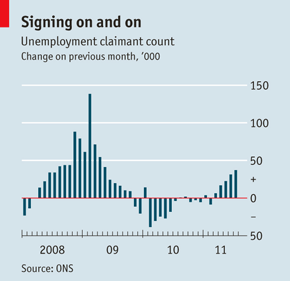
Well, one indicator is the job growth rate, since a big part of the stimulus was to get the labor market moving again. Take a look at the chart below from The Economist:


See that big spike? That's February 2009 - the month the stimulus was signed into law. We see an immediate and steep decline in jobless claims, which once the money started being received around April 2009, declined steadily until joblessness plateaued around the middle of 2010, presumably after many of the jobs created by the stimulus had been filled. But stimulus money began to run out for many of the projects over the past few months and look at that ... jobless claims are climbing again in mid-2011. But remember, the stimulus didn't work.

Now lets look at the effect on GDP.


So by the 2nd quarter 2009 (this isn't fiscal quarters) we see a big bump, coinciding again, with the stimulus package. Yes, GDP is a very gross measure, but there wasn't a whole lot going in with the economy at this point so how else do we explain this rapid movement from -4% retraction to +4% growth in just 2 quarters? It's tough to explain otherwise. Sure, the Fed was doing its own tweaking of the economy, but it would be tough to imagine that infusing the economy with an additional ~$150B in spending each quarter wasn't helping anything. To claim that the stimulus didn't work.

So what's been happening as the stimulus has wound down? No big surprise. Growth is anemic. The original 1.9% 1st quarter GDP in 2011 (seen in the 2nd figure above) was revised down to just 0.4% "growth" ... and the 2nd quarter wasn't much better at 1.3%. The slowest growth since the stimulus package was enacted 2 years ago. Some economists (those with a mind of their own?) now think we're headed to a double dip recession as the stimulus funding runs out and austerity cuts are enacted at the wrong time.

Notice nobody's come back out and admitted they were wrong? Not a big surprise, really. Ideologues, politicians, and capitalists can't (or won't) change their spots.

Friday, January 21, 2011

It's the economy, stupid (again).

For much of 2009 I think much of the country was perplexed by Washington, DC's focus on health care reform. The economy was in shambles, businesses were hemorrhaging jobs, home foreclosures hit record highs. And the politicians were busy in their big marble buildings negotiating (or filibustering) on issues related only to health care.

A case could be made that health care reform was addressing the longterm health of the economy, but I won't make that argument, because too much of the cost control needs were kicked down the road to worry about later. That said, health care reform represented an enormous victory for progressive ideals. For egalitarianism. For the believe that nobody should go bankrupt because they get sick.

Granted early in 2009 a first stimulus was passed and immediately excoriated  by the Republican party as not working - even as they took credit for its job creation in their home districts. Politicians are nothing if not opportunistic.

Finally, in 2010 the powers that be got down to business by passing the Dodd–Frank Wall Street Reform and Consumer Protection Act- a reform measure intended to reign in the excesses of the financial industry and protect average investors from predatory behaviors. This again didn't directly address jobs and the economy, but will hopefully help avoid future Wall Street initiated weapons of mass destruction. 

Despite these gains, the public punished Democrats for a lackluster economic recovery, putting the GOP in charge of the House of Representatives in the 2010 midterm elections. 

What's their first order of business?

A symbolic repeal of the health care reform law. Mission accomplished. The entirely meaningless repeal was passed with no hope of escaping the Senate. Well done.

Their second?

An attempt to limit the Environmental Protection Agency's ability to protect the environment. No surprise from a party that has demonstrated time and time and time again that they're more interested in protecting businesses than the people of this country.


I'm guessing I know what's third.

Representative Michelle Bachmann (R-MN) has proposed a repeal of the Dodd-Frank Wall Street Reform and Consumer Protection Act. I mean, why protect consumers when bank profits are threatened?

Of course, even if the House passes all of this legislation, it won't pass the Senate. These are all symbolic votes. Which means what? It means they are a waste of time.

At least one Republican gets it. Something Democrats tend to forget is that even though Joe Miller lost the election for an Alaska Senate seat, he lost to a write-in Republican. Fortunately, Lisa Murkowski (R-AK) represents one of the few voices of reason left on the right. She's come out with this gem:

I don't believe that there are votes sufficient in the Senate to repeal health care reform....We're in this situation where there is some messaging going on ... The real question is how much time do we as a Congress spend on this messaging? We've got a situation where our economy continues to be in the tank, the longest extended period of high unemployment since World War II. ... As important as making sure that we're reining in our health care costs -- spending a lot of time on the messaging vote? I don't think that's what the American public wants us to do. ... I don't think what people want is kind of the messaging that's going on.
 I guess this is why the tea party wanted her out of office. She's too pragmatic. Why get down to resolving the economic calamity when time could be spent symbolically voting against things that don't have a chance in hell of being changed?

Of course the cynic in me realizes that the longer the economy is in the toilet, the better the GOP's chances of taking the White House in 2012. Since Senator Mitch McConnell (R-KY) has already said that Job #1 is making Obama a one term president, I guess getting to things like economic recovery would not be a priority. The well-being of the American people isn't nearly as important as controlling the executive branch of government.